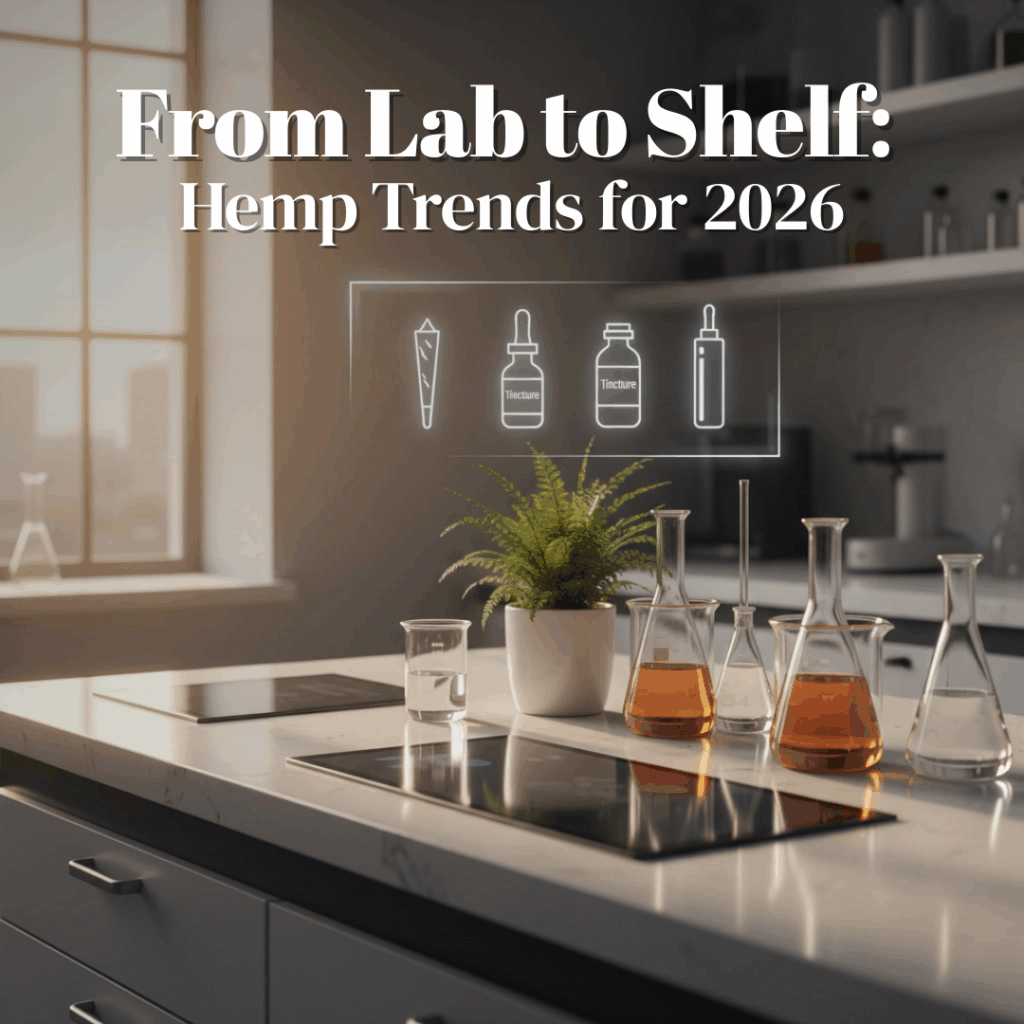
2025 has been a year of rapid change for hemp: technological advances, new product formats, and shifting regulatory pressure combined to reshape the marketplace. For retailers, brands and consumers, understanding these trends is essential to stay competitive, compliant, and customer-focused in 2026.
Smarter Delivery
One of the most important product-level advances this year has been the continued commercial roll-out of nanoemulsion and microemulsion technologies. These formulations meaningfully increase the bioavailability of hemp extracts, producing faster onset and more consistent experiences at lower doses. Expect more brands to launch “fast-acting” lines and for retailers to emphasize product education — not just potency — when merchandising.
Clean Label Demand
Consumer preference has continued to tip toward solventless extracts (live rosin, solventless hash) and full-spectrum ingredients with transparent lab pages. Craft-oriented products that highlight strain origin, extraction method and lab results outperformed generics across several markets in 2025. Stocking curated, well-documented items and training your team to explain the differences increases trust and conversion.
Testing, traceability and lab standards
Post-2024 regulatory attention accelerated investment in laboratory infrastructure and traceability systems. Brands that publish batch-level COAs, use third-party testing partners, and adopt standardized potency reporting saw higher online discoverability and fewer customer disputes. Investing in inventory tracking and clear labeling reduces risk, particularly around interstate sales.
Retail formats: single-serve, ritualized offerings
New formats — single-serve microdoses, ritual boxes, and curated “self-care advent” kits — became a holiday and gifting staple this year. These SKUs are ideal for web promos and social content because they simplify purchase decisions and lower barriers for new customers.
Policy and market risk
Regulatory activity remains the central risk. During 2025, federal-level discussions around intoxicating hemp isomers produced uncertainty for product categories like edibles and certain concentrates. Retailers must monitor federal guidance and state enforcement priorities; a nimble assortment strategy (promote non-intoxicating topicals, broad-spectrum items) will protect revenue while staying within compliance.
Practical takeaways for retailers
- Highlight bioavailability & formulation benefits in product descriptions.
- Prioritize lab transparency and full COAs on product pages.
- Test single-serve & ritual bundles for holiday sales; promote on email & organic social.
- Develop an inventory contingency plan for product categories at risk from regulatory shifts.
- Train staff on product education and compliant language.
Why this matters for customers
Shoppers want fast results, clean processes and clear information. Retailers that translate scientific advances into simple consumer benefits — faster onset, cleaner ingredients, trustworthy lab data — will win loyalty in 2026.